

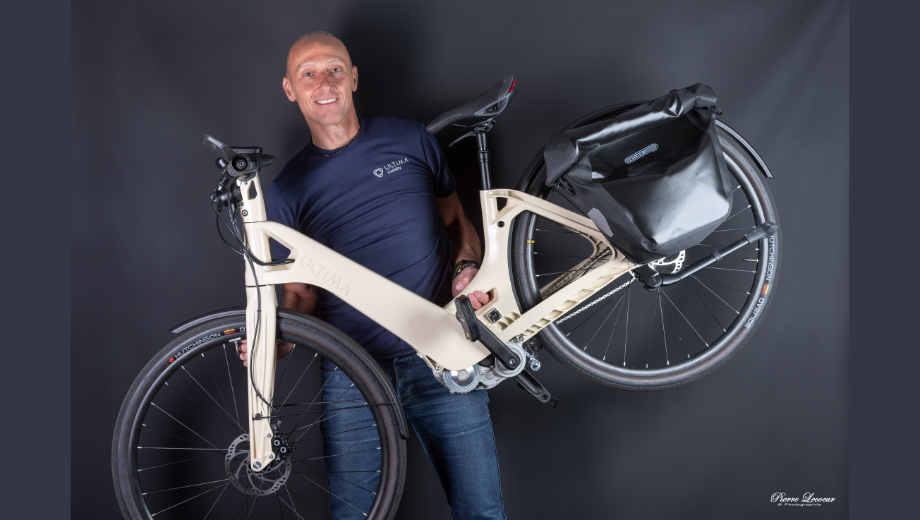
For many years, I've enjoyed introducing myself using Ralph Waldo Emerson's quote, "Do not go where the path may lead, go instead where there is no path and leave a trail." To move forward, it's essential to know oneself well and to be able to define one's strengths and weaknesses. Perhaps in another blog post, I will share my thoughts on this long construction process, the keywords of which remain "curiosity and daily learning."
Initially, it's crucial to understand one's deep motivations and what makes something pull you out of sleep every night, making you vibrate or awakening your interest to start a day with a smile and a thirst to progress. For me, several fundamental pillars build this spiritual nourishment:
- Mobility: cycling, motorcycling, driving, without ever being able to define my favorite.
- The desire to learn and an endless curiosity with a self-taught approach.
- Sports: running, cycling, triathlon, but also motor sports.
- Innovation and an endless struggle against "it's not possible."
- An openness to the world that allows me to listen to my fellow human beings and often makes me say that I am a man of this planet and therefore "without labels," meaning "open, curious, eager to learn from others, without preconceptions."
It was in the 90s that Brice (my partner at ULTIMA) and I were able to test our complicity and shared vision of work through student projects that already demanded creativity, passion, and commitment, including challenges in sports, particularly rather intense bike rides. Our professional paths then diverged, but we never lost contact.
This period allowed me to lead numerous projects in creation, development, industrialization, turnaround, or partnership, and consequently, to better and better learn my profession as an entrepreneur through both successes and failures. It was between 2016 and 2017 that the sky cleared, and the puzzle around my motivations began to cohere. When you started working on your first cars in 1984, and 30 years later you realize that the path taken is becoming a dead end, you conclude that mobility must change and offer different solutions. This transition and broader vision of mobility would find its full inspiration in a counter-intuitive logic, knowing that at the time I had access to all the data needed to develop high-end cars that seemed to be slowly turning into vans.
My point is not to oppose SUVs and light mobility, but to make them complementary; to leverage my acquired expertise to serve a broader, imperative goal, including ecological transition and the need to rethink travel. Without delving into the economic magnitude, we observe that many families have two vehicles, and neither of them is truly suited to the urban environment. It was therefore necessary to diversify the offerings and provide different objects and also different modes of acquisition. For someone to use an SUV for a Lyon-Paris trip or to go on vacation with three children makes perfect sense, and for that, there's no need to carry a hybrid with 500kg of batteries for nothing. But when driving in the city and taking a child to school or activities, a scooter, a license-free car, a cargo bike, or a regular bicycle are largely sufficient!
At that time, I was fortunate to participate in the strategy of a large international group and to understand that vehicles in the 2020s would increasingly resemble Mega-SUVs, and some even thought that a market of 100 million vehicles could gradually become 100 million SUVs with different levels of electrification, which seemed to me to be a mistake! During the same period, I participated in my company's strategic planning and was able to develop my thinking around "light is right" without, however, convincing the board members to whom I reported.
Becoming a leader has this magical aspect: you have to decide and move forward one step each day, and thus find a compromise between a long-term vision and daily decisions that can sometimes introduce "noise" into your initial plan. But as my English friends like to say, "strategy is for breakfast and then there is a lot of noise."
Building a strategy and learning from our mistakes is precisely what we business leaders must keep in mind and find a balance between experience, wisdom, and risk-taking, surrounding ourselves with both experts and visionary, creative, agile individuals. Very pragmatically, I have retained several things from these past experiences that nourish my daily life:
- Protecting and developing our know-how with a delicate balance between localization and globalization.
- Being a "cost killer" but not at all costs, and not turning our know-how into a low-cost commodity.
- Being convinced that a sum of small initiatives can ultimately give more strength to a sector or branch.
- Not developing in a single branch and knowing how to diversify our model in terms of products and geography.
- Implementing a vision and a plan and not necessarily responding to the dashboards that your shareholders, bankers, and investors brandish every morning, with the risk of making bad decisions or falling into a "copying is winning" logic and dulling your differentiating factors.
After this introduction, which allows you to better understand where I come from, I would like to return to the ULTIMA project and this wonderful opportunity to work on the mobility of tomorrow. Local mobility is undergoing a profound transformation, and many users hesitate to take the plunge due to conventional offerings and solutions that are not adapted to their needs.
At the launch of this project, Brice, Didier (my two partners in the ULTIMA project), and I decided beforehand that our first offering would be a bicycle, "Le MULTIPATH," and it had to be designed to provide a breakthrough offering based on three fundamental pillars:
1- Product innovation serving safety, modularity, and customer comfort to facilitate its use.
2- Technological innovation serving relocalization with eco-responsible sourcing.
3- Commercial innovation to offer the ideal custom-built object, delivered within 21 days thanks to localization and demand-driven production through our short supply chain and the support of our partners.
First Pillar
Did you know that 40% of French cyclists are stressed at the idea of taking their bike to work in the morning?
Ultima has designed a bike that allows 100% concentration on the road and the environment in which customers operate.
The Multipath has been designed to bring to the market all available innovations in the service of customer safety and comfort:
- An e-bike weighing less than 20kg with a 630 Wh battery, giving it a range of up to 100 km.
- An agile bike with an open frame to allow everyone to easily handle it.
- An automatic gearbox that facilitates riding and allows you to stay focused on the road.
- Four levels of anti-theft with the classics (engraving and padlock) but also a GPS tracker and the possibility of remotely disconnecting the transmission to convert the bike into a balance bike.
- A frame design that adapts to several family members from 1.4m to 1.9m.
- On-demand modularity with 4 variations: City, Trekking, Cargo, and Family Cargo.
Second Pillar
Innovation in the service of localization!
The strength of innovative technologies is to manufacture these components Made in Europe while remaining competitive against Asian competition. Our injected carbon frame uses recycled material that will also be recyclable at the end of its life, and this concept has been patented!
ULTIMA's strength lies in its ability to work with different types of industrial partners: "big players" like Valeo and its MIF motor, small start-ups with innovative ideas but lacking the power and experience to industrialize them, or historical automotive suppliers facing reduced activity with the capacity to support us in this new project.
Our ambition is to localize 90% of our components in France and 100% of our components in Europe. Currently, it's 98% by value, and we will reach 100% by early 2023.
Next, we will need to work with suppliers' suppliers to ensure that 80% of the value is sourced in Europe. "Made in EU" is extremely virtuous because it reduces the carbon footprint by a factor of 10 simply by comparing supply chains.
Third Pillar
This last pillar was born from the optimization of the two previous pillars – "a modular product, a short supply chain" – and it allows us to produce bikes on demand based on an ideal configuration chosen by the customer, with delivery in 2 or 3 weeks.
Conclusions
As you now well understand, ULTIMA does not propose a revolution but a necessary evolution for this ecosystem to help it remain competitive and European.
ULTIMA Mobility began production at the end of September, and our first customers are happy to enjoy all the virtues of our products and thus have more eco-responsible mobility.
All of this would not have been possible without the help of a team that brings together many talents, both young and older, to allow us, through our own work or our associations with partners, to maintain a solid course between creativity and pragmatism in order to put our expertise at the service of tomorrow's technologies.
Share:
Introducing Théo!
Hello Jules!