

In the world of urban e-bikes, a persistent misconception has long held sway: to have power and battery life, you have to accept a heavy and difficult-to-maneuver bike. Today, the expectations of urban cyclists are evolving. The search for lightness has become a central criterion for those who want a dynamic, easy-to-ride, and practical bike for everyday use.
To understand what lightness truly changes in the feeling of using a bike, we focus on the advantages of this new category of e-bikes, drawing inspiration from the innovations of the French brand Ultima Mobility.
Why choose a lightweight electric bike?
The lightness of an e-bike is not just a simple number on the scale: it completely redefines the riding experience and the logistics of your journeys.
-
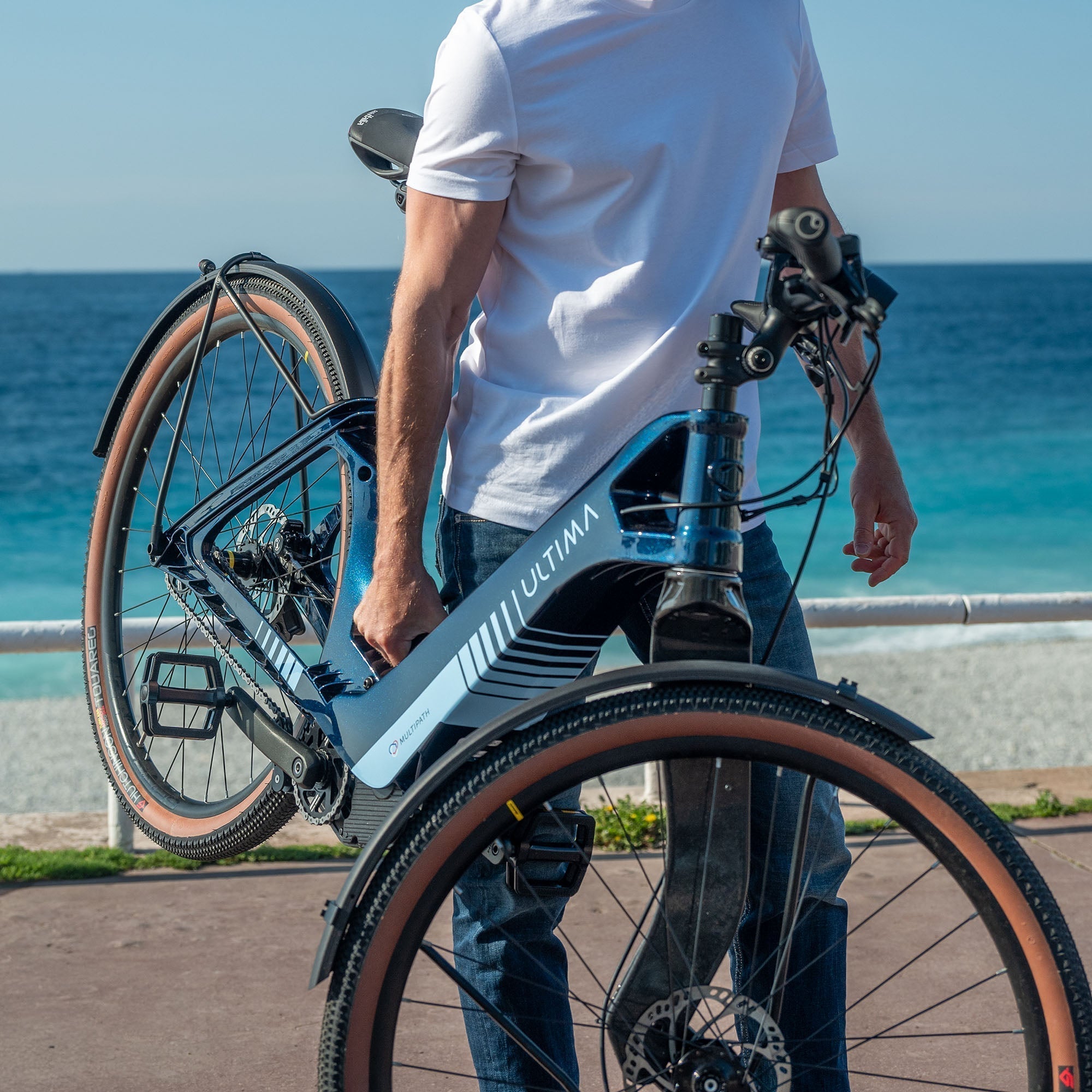
Agility and natural handling: A lighter electric bike (around 22-25 kg, like Ultima's Multipath) offers sensations close to a classic bicycle. Accelerations are brisk, steering is precise, and the bike moves with great fluidity in urban traffic.
-
No more logistical hassles: Carrying your bike up a few steps, taking it into an apartment, hanging it on a train, or simply pushing it when assistance is off: every kilogram saved translates into immediate comfort in daily tasks.
-
Optimized range: Less weight to move means the motor consumes less energy with each acceleration. Rather than installing giant, heavy batteries, lightweight bikes prioritize energy efficiency.
Selection criteria for different types of lightweight e-bikes
To design a bike that is both lightweight, robust, and high-performing, manufacturers rely on advanced technologies. Here's what to look for before buying:
1. Frame materials: the example of recycled carbon
The frame is the main component determining the bike's weight. While standard aluminum shows its limitations, Ultima Mobility stands out with a major innovation: an injected recycled carbon and composite frame. This exclusive technology drastically reduces weight while offering exceptional rigidity, natural damping of urban vibrations, and minimal environmental impact (the frame being fully recyclable).
2. Motor and drivetrain
On a lightweight bike, component integration must be precise. Choosing a high-end mid-drive motor, like the Cyclee by Valeo system, allows for combining powerful torque (up to 130 Nm) with an integrated automatic gearbox. This eliminates fragile derailleurs, reduces maintenance, and maintains perfect mass balance to avoid making the ride heavy.
Modularity and ergonomics in transport
A bike that justifies its price must adapt to real life. Essential selection criteria include:
-
Smart single size: a well-designed frame, thanks to specific geometry and an adjustable stem, should be suitable for multiple family members (from 1.40 m to 2 m).
-
Discreet integrated equipment: high-performance lighting connected directly to the battery, robust mudguards, and hydraulic disc brakes for safe stopping, regardless of the cyclist's weight.
FAQ: Lightweight electric bikes in daily life
Is a lighter bike less stable on the road?
On the contrary. Stability mainly depends on mass distribution. By placing the motor and battery centrally and as low as possible (at the bottom bracket), a lightweight bike offers an optimal center of gravity that keeps the bike glued to the road, even at sustained speeds.
Is a recycled carbon frame as strong as a classic frame?
Yes, and sometimes more so. The injected monocoque technology used by Ultima offers excellent resistance to impacts and mechanical stresses of the city, while avoiding the weak points of traditional welds.
What is the range of a lightweight urban e-bike?
Lightweight models are designed for real life: the average range is around 80 km depending on the assistance modes. This is more than enough to cover a full week of daily home-to-work commutes (bike commuting) without needing to recharge every evening.
Share:
Electric bike for commuting: the bike-to-work guide
Electric Gravel Bikes: The Complete Guide